
After speaking with hundreds of property buyers and investors, I’ve noticed a pattern.
Most people don’t lose money because they picked the wrong developer. They lose money because they misunderstood how the market actually works.
Real estate isn’t only about location or launch prices. It’s also about buyer psychology, payment structures, and future demand.
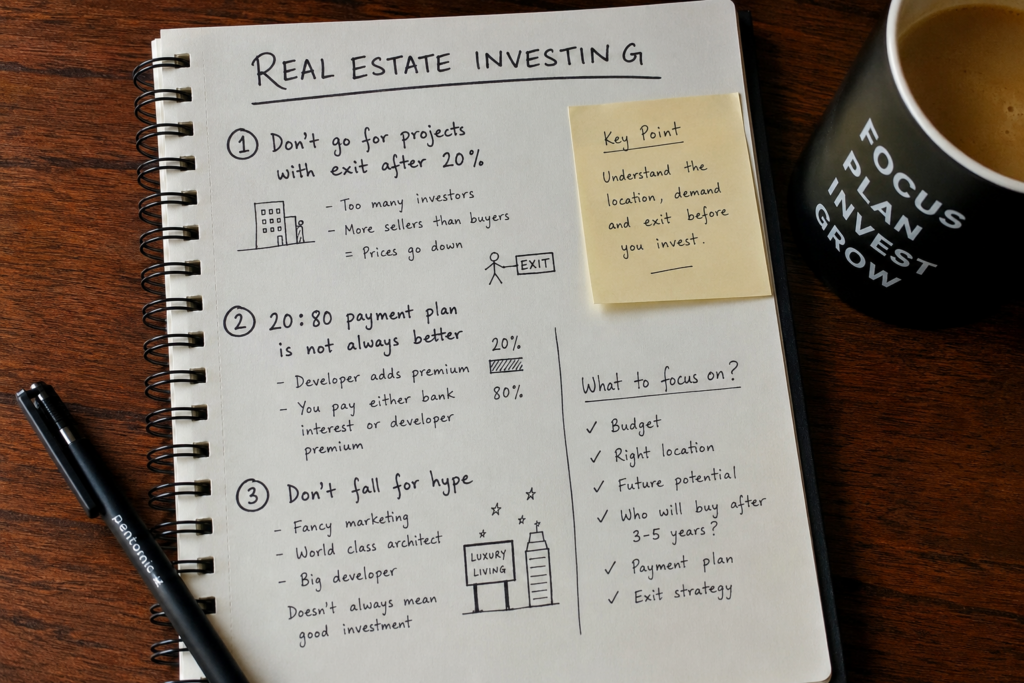
Here are three mistakes I believe every investor should think about before booking a property.
1. Don’t Get Carried Away by Projects That Require Only 20% Upfront
At first glance, paying only 20% before getting an exit option sounds attractive. Lower investment, lower risk. Right?
Not always.
These projects often attract a large number of buyers whose plan is not to own the property, but simply to exit before the next payment becomes due.
Some may have limited capital. Some may not even qualify for a home loan. Others are entering because the initial commitment is small.
The problem starts when many of them try to sell around the same time.
If too many investors want to exit before the next installment, the market suddenly has more sellers than buyers. That can put pressure on resale prices and make exits harder than people expected.
This doesn’t mean every such project will perform poorly. It simply means you should understand who else is buying and whether the payment structure encourages short-term speculation.
2. A 20:80 Payment Plan Isn’t Automatically a Better Deal
Many buyers assume a 20:80 payment plan saves money because most of the payment is made at possession.
But there is another side to it.
Developers often price these plans differently. The convenience of deferred payment may already be built into the property’s cost.
Whether that premium is worth paying depends on your investment horizon.
If you’re planning to hold the property until possession or for several years after that, the payment plan may suit your needs.
However, if another buyer purchases the same unit through a regular construction-linked plan at a lower price, they begin with a cost advantage that can matter when it’s time to sell.
Instead of comparing payment plans, compare the total cost of ownership.
3. Don’t Buy the Hype. Buy the Future.
Every launch has a story.
A famous architect.
Luxury branding.
The next landmark address.
A new business district.
Marketing creates excitement, but excitement alone doesn’t create long-term appreciation.
Even the presence of a well-known developer doesn’t automatically make a location a great investment. Sometimes developers acquire land simply because it is available at an attractive price or because they want a presence in that micro-market.
The better question to ask is this:
Who is likely to buy or rent here five years from now?
If employment, infrastructure, connectivity, schools, hospitals, and everyday convenience are improving, demand has a stronger foundation than any marketing campaign can create.
Final Thoughts
Real estate rewards patience far more than excitement.
Before investing, don’t just ask whether the project is selling well today.
Ask whether there will be genuine demand tomorrow.
Understand the payment plan.
Think about your exit strategy.
Study the location beyond the advertisements.
The best investments are rarely the ones making the most noise. They’re usually the ones where the fundamentals quietly make sense.