
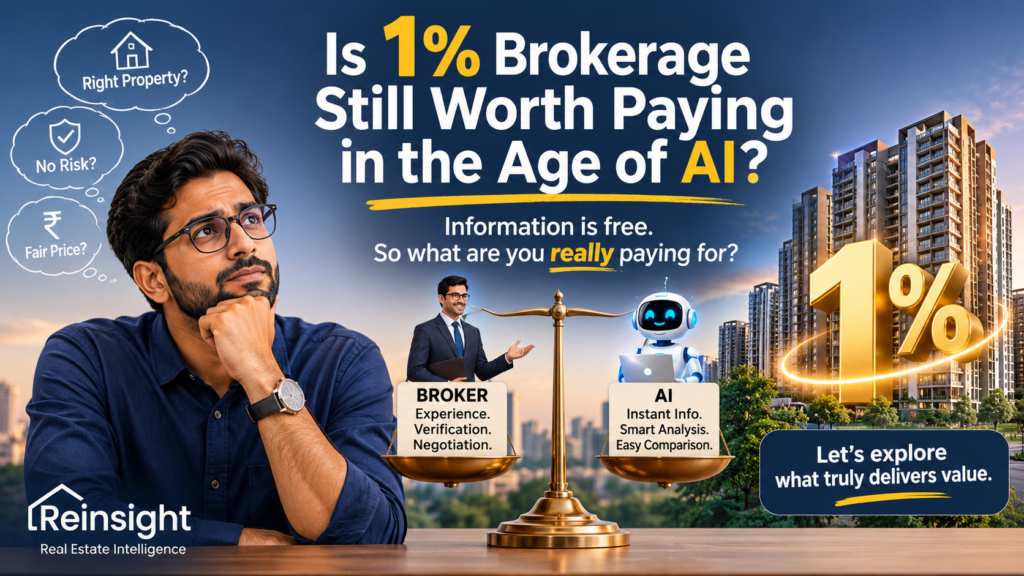
When information is becoming cheaper, what exactly are you paying your real estate broker for?
Let’s start with a simple question.
Why does a real estate broker charge 1% of a property’s value?
If you purchase a property worth ₹2 crore, 1% brokerage amounts to ₹2 lakh.
But what determines this price? Is it the time invested, the effort involved, the value of the transaction, the expertise required or the experience delivered?
And with Artificial Intelligence now capable of researching, comparing and analysing properties, does a traditional broker still deserve 1%?
To understand this, let’s look beyond real estate.
1. Why does a gardener charge more per minute than a maid?
Consider two everyday services.
A gardener might charge ₹10–20 for digging and maintaining an individual plant. The work takes approximately 2–3 minutes, and its results may last five or six days.
A domestic maid might charge ₹2,000 per month for sweeping, mopping and washing utensils. The work takes considerably longer, but the very next day, the house needs cleaning again.
Interestingly, the gardener might earn ₹5–8 per minute, whereas the maid might earn approximately ₹1 per minute.
Yet, paying a gardener ₹2,000 every month might feel expensive, while paying the same amount to a maid feels reasonable.
Why?
Because we don’t evaluate the price of a service only by the time it takes to deliver it.
We subconsciously consider:
- How frequently do we need it?
- How long does the result last?
- How important is the service?
- How easily can we find an alternative?
- What happens if we don’t get the service?
The gardener provides an occasional service whose results last several days. The maid provides a recurring service whose results need to be maintained daily.
This tells us something important:
The price of a service is influenced by its frequency, utility, duration of benefit, availability and the importance of the outcome.
Real estate brokerage operates on a very different economic model.
A person might buy groceries every week, hire domestic help every month and purchase a house only once or twice in their lifetime.
And unlike most everyday purchases, buying a property involves a substantial amount of money, long-term financial commitments and consequences that can last for decades.
This brings us to the next question.
2. Why does a real estate broker charge 1%?
Imagine purchasing a property worth ₹2 crore.
At 1% brokerage, the broker earns ₹2 lakh.
Now imagine the actual transaction requires:
- Understanding your requirements.
- Shortlisting suitable properties.
- Researching projects.
- Arranging site visits.
- Comparing specifications and prices.
- Discussing payment plans.
- Negotiating commercial terms.
- Coordinating documentation and booking.
You might wonder why someone should earn ₹2 lakh for a few days or weeks of work.
But are you really paying for those working hours?
Not entirely.
A good professional brings accumulated experience, market knowledge, access to information, negotiation skills, problem-solving ability and an understanding of the transaction process.
The customer isn’t simply paying for the hours spent.
They are potentially paying for the knowledge and judgement accumulated over years, applied to a decision that could affect their financial future.
However, there’s an important distinction:
The value of a transaction does not automatically determine the value of the broker’s contribution.
A ₹2 crore property doesn’t automatically justify ₹2 lakh in brokerage.
The broker must deliver a service that makes that fee worthwhile.
And this is where another interesting concept comes into the picture.
3. A five-star hotel doesn’t sell you just a room. It sells you an experience.
Consider booking a hotel.
You can find a room for ₹1,500, ₹5,000 or ₹25,000 per night.
All three might provide you with a bed, a bathroom, air conditioning and a place to sleep.
So why would someone pay ₹25,000 when a ₹5,000 room could fulfil the basic requirement?
Because they aren’t purchasing just a room.
They’re purchasing an expected experience.
- Quality of hospitality.
- Ambience and comfort.
- Attention to detail.
- Personalised service.
- Convenience.
- Responsiveness.
- Consistency.
- Confidence in the standard of service.
A five-star hotel communicates an expectation of how you will be treated.
The customer isn’t paying five times more simply because the bed costs five times more.
They’re paying for the experience surrounding the basic service.
Of course, the price alone doesn’t guarantee a five-star experience. The hotel must deliver what its positioning promises.
And this principle applies to service businesses across industries.
A premium restaurant doesn’t just sell food. A luxury car dealership doesn’t just sell a vehicle. A premium airline doesn’t just sell a seat.
They sell an experience associated with the service.
Price is not merely the cost of delivering a service. It also communicates the level of experience a customer can expect.
Now let’s bring this principle into real estate.
4. Two brokers can charge the same 1%, but offer completely different experiences.
Consider two brokers facilitating the purchase of the same ₹2 crore property.
Both charge ₹2 lakh.
But what does the buyer actually receive?
Broker A: The transaction facilitator
- Shares available inventory.
- Arranges property visits.
- Explains developer offerings.
- Follows up for booking.
- Coordinates the initial transaction.
This broker helps the buyer complete a purchase.
There is nothing inherently wrong with this service. Convenience and access have value.
But much of the information being provided is increasingly available elsewhere.
Broker B: The buyer-side adviser
- Understands the buyer’s financial capacity and actual requirements.
- Studies multiple projects before recommending options.
- Compares prices, configurations and specifications.
- Evaluates available developer track records.
- Identifies potential risks and unanswered questions.
- Separates verified information from marketing promises.
- Helps negotiate commercial terms.
- Coordinates the transaction.
- Provides defined support after booking.
Both brokers charge 1%.
But the experience they offer is fundamentally different.
The first primarily facilitates a transaction.
The second attempts to improve the quality of the buyer’s decision while also facilitating the transaction.
The difference isn’t necessarily in the amount of time spent.
It is in the depth and quality of service delivered.
5. Now comes AI. Is the traditional broker’s advantage disappearing?
Until recently, real estate brokers enjoyed a significant information advantage.
They knew which projects were available, which developers were launching, what the prices were, what inventory remained and which payment plans were being offered.
For many buyers, finding and comparing properties independently was difficult.
The broker became the primary source of information.
But AI is changing this relationship.
Today, a buyer can use AI to:
Find and compare properties
Search for projects based on location, budget, configuration, amenities and other requirements.
Calculate affordability
Understand down payments, EMIs, loan requirements and different payment scenarios.
Research developers
Analyse publicly available information about completed projects, delivery history, disputes and reputation.
Compare projects
Create structured comparisons of prices, specifications, configurations and amenities.
Understand locations
Study connectivity, infrastructure announcements, employment hubs and surrounding development.
Understand agreements
Summarise legal documents, explain contractual language and identify clauses that deserve professional review.
Analyse investments
Model potential returns, rental yields, holding periods and different appreciation scenarios.
Tasks that once required several hours of information gathering can now be completed much faster.
This is a significant shift.
The buyer no longer needs to depend entirely on a broker to know what is available in the market.
And this raises an uncomfortable but necessary question:
If AI can find, compare, research and analyse properties, why should someone pay a broker 1%?
The honest answer is that not every broker will continue to deserve it.
6. What AI can do versus what a good broker must still do
To understand the future of brokerage, we need to distinguish between three things: information, intelligence and execution.
A. Information: AI is becoming exceptionally good at this.
Information tells you what exists.
For example:
- A project has 500 apartments.
- The developer is quoting ₹12,000 per sq. ft.
- The property is located near an expressway.
- Possession is scheduled for 2030.
- The project offers particular amenities.
AI can gather, organise and compare much of this information.
A broker who charges a premium simply for sharing information will increasingly struggle to justify the fee.
B. Intelligence: AI can assist, but judgement matters.
Intelligence is about interpreting information.
For example:
- Is ₹12,000 per sq. ft. a reasonable price?
- Does the developer’s track record support its current commitments?
- Is the location’s growth potential supported by actual development?
- Is this project suitable for an end user or an investor?
- Are there better alternatives within the same budget?
- Is the buyer taking more financial risk than they realise?
AI can help answer these questions, but its conclusions depend on the accuracy and completeness of the underlying information.
It may also present incorrect or outdated information with confidence.
A professional must know how to question the output, verify important claims and apply real-world context.
C. Execution: The real world still matters.
Execution involves making things happen.
- Visiting actual project sites.
- Assessing ground-level surroundings.
- Checking the actual unit and its availability.
- Speaking with relevant stakeholders.
- Negotiating commercial terms.
- Coordinating documentation.
- Following up on commitments.
- Helping resolve transaction-related problems.
AI can assist with research, communication and coordination.
But it cannot independently guarantee physical verification, ensure another party honours its commitments or take responsibility for every real-world outcome.
And a broker should also know when to involve qualified lawyers, engineers, architects or financial professionals.
AI can make information accessible. A good professional must turn information into informed action.
7. The hidden cost of a bad property decision
Let’s return to our ₹2 crore property.
A buyer might spend weeks negotiating ₹20,000 or ₹30,000 of brokerage.
But what if they overlook a much larger financial risk?
For example:
- Paying ₹5 lakh more than a reasonable market price.
- Choosing a developer with a weak delivery record.
- Buying a configuration with limited resale demand.
- Misunderstanding the payment plan.
- Ignoring additional charges.
- Depending on infrastructure that hasn’t been approved or funded.
- Purchasing a property that doesn’t suit their financial capacity.
A mistake in the buying decision can cost substantially more than the brokerage itself.
This doesn’t mean that paying a broker guarantees protection from every mistake.
Nor does it mean that a broker can always predict future property prices.
It means that buyers should evaluate professional fees against the quality of the advice, verification and support they receive.
There is a difference between paying someone to help you complete a transaction and paying someone to help you understand the transaction before committing your money.
The second service can have significantly greater value.
8. Does every service business deserve premium pricing?
No.
And this is an important distinction.
A business cannot simply charge more and call itself premium.
A five-star hotel must deliver a five-star experience.
A premium restaurant must consistently deliver quality, hospitality and ambience.
A premium real estate advisory must deliver a level of research, transparency, responsiveness and professional support that justifies its positioning.
The customer should experience the difference.
This is why service businesses need to think beyond their core deliverable.
A real estate broker’s service isn’t limited to finding a property.
It also includes how the customer is treated throughout the journey.
Consider the buyer’s experience:
- Does the broker listen before recommending?
- Does the broker respect the buyer’s budget?
- Does the broker explain disadvantages as openly as advantages?
- Does the broker respond when the buyer has doubts?
- Does the broker provide evidence for important claims?
- Does the broker disclose relevant commercial interests?
- Does the broker remain available after receiving brokerage?
These details shape the customer’s perception of value.
A customer might forget the number of projects a broker showed them.
But they are unlikely to forget whether the broker pressured them, misled them or genuinely helped them.
A premium service is not defined by what the business claims. It is defined by what the customer consistently experiences.
9. The future of real estate brokerage: AI-powered, human-led
I believe the brokerage industry is heading towards a significant transformation.
The broker who relies on information scarcity will face increasing competition.
The broker who uses AI to improve the quality, speed and depth of their service can become considerably more productive.
Imagine a buyer approaches a real estate advisory firm with a budget of ₹2 crore.
Instead of spending several days collecting brochures and calling different developers, the firm could use AI-assisted research to:
- Understand the buyer’s requirements.
- Analyse affordability and financial exposure.
- Screen 100 available projects.
- Identify 10 potentially suitable options.
- Narrow those down to four or five through further evaluation.
- Prepare structured comparisons.
- Identify claims requiring independent verification.
- Arrange relevant site visits.
- Help the buyer evaluate alternatives.
- Coordinate the transaction and agreed post-booking support.
The buyer receives a more structured experience.
The adviser spends less time on repetitive information gathering and more time on evaluation, verification, communication and execution.
This is where AI becomes an advantage rather than a threat.
But there is another consequence.
As technology reduces the cost of research, buyers will become more demanding.
They will expect faster responses, better comparisons, more transparency and greater accountability.
The standard of brokerage will have to rise.
10. What should 1% brokerage actually buy?
Perhaps the industry needs to rethink how it communicates brokerage.
Instead of presenting 1% as a fee for showing properties, it should represent a clearly defined professional service.
For a buyer-side real estate advisory, that service could include:
| Service | Expected value to the buyer |
| Requirement assessment | Clarity about actual needs |
| Financial assessment | Understanding affordability and payment exposure |
| Market research | Relevant project and market comparisons |
| Developer evaluation | Assessment of available track record and commitments |
| Property evaluation | Understanding suitability, pricing and risks |
| Negotiation | Assistance with commercial terms |
| Transaction coordination | Support through booking and documentation |
| Post-booking assistance | Follow-up and coordination towards possession |
The scope should be transparent from the beginning.
If the broker is receiving compensation from the developer, that relationship should also be disclosed.
A buyer deserves to understand whether the person advising them has commercial interests that could influence their recommendations.
Trust is not built by avoiding uncomfortable questions.
It is built by answering them honestly.
11. What does this mean for Reinsight?
At Reinsight, we believe buying a property should begin with understanding, not booking.
We don’t believe that every expensive property is a good property.
We don’t believe that every new launch is a good investment.
We don’t believe that every infrastructure announcement guarantees appreciation.
And we don’t believe that a buyer should book simply because someone says the opportunity is limited.
Our approach is to understand the buyer’s requirements, evaluate available options, compare projects and help them make a decision based on their financial capacity and actual needs.
AI can help us research faster, analyse more information and create better comparisons.
But the responsibility to question information, verify important facts, understand the buyer and provide meaningful guidance remains central to the service.
Our objective isn’t to show a buyer 100 projects.
It is to study the market, narrow down the possibilities and help them understand why four or five options deserve consideration.
Because buying a property shouldn’t be about how many options you have seen.
It should be about how well you understand the option you finally choose.
Conclusion: Is 1% brokerage still worth paying in the age of AI?
The answer depends on the experience and value being delivered.
If you’re paying someone merely to share property options, arrange visits and repeat information available elsewhere, questioning 1% is perfectly reasonable.
But if you’re paying for meaningful research, independent evaluation, informed judgement, ground-level verification, negotiation and reliable transaction support, the equation changes.
AI has made information cheaper.
It has made research faster.
It has made comparison easier.
But it hasn’t eliminated the need to verify facts, understand consequences, make difficult decisions and execute them in the real world.
The future broker cannot survive merely by knowing which property is available.
They must understand why a property deserves consideration, why another should be avoided, what the buyer might be overlooking and what needs to happen next.
And perhaps the most important shift is this:
The future of brokerage isn’t about convincing buyers that 1% is worth paying. It’s about creating an experience where the buyer understands the value they are receiving in exchange for it.
You don’t choose a five-star hotel simply because you need a bed.
You choose it because of the experience you expect.
Similarly, you shouldn’t choose a real estate adviser merely because you need someone to show you a property.
You should choose one because of how you expect your entire buying journey to be handled.
Information is becoming a commodity. Experience, judgement and trust are becoming the differentiators.
Reinsight | Real Estate Intelligence
Better information. Better evaluation. Better decisions.