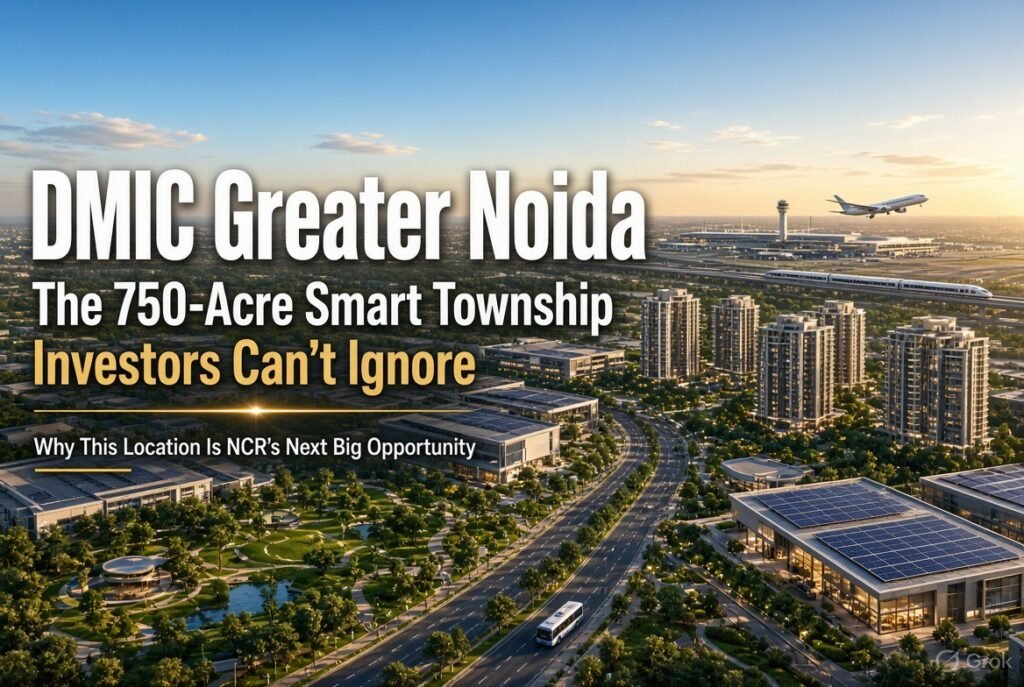
The Delhi-Mumbai Industrial Corridor (DMIC) is one of India’s most ambitious infrastructure programmes — a 1,500-km backbone designed to create world-class industrial cities, logistics hubs and liveable urban centres. Right in the heart of the National Capital Region sits one of its standout early-bird projects: the Integrated Industrial Township Greater Noida (IITGN) — a meticulously planned ≈750-acre smart township that is now attracting major residential developers and long-term investors.
What Exactly Is the DMIC Integrated Industrial Township?
Spanning roughly 747–750 acres southeast of Greater Noida (near the Eastern Peripheral Expressway and Delhi-Howrah railway line), IITGN is being developed by DMIC Integrated Industrial Township Greater Noida Limited (IITGNL) — a 50:50 joint venture between the National Industrial Corridor Development & Implementation Trust and Greater Noida Industrial Development Authority.
It is designed as a true mixed-use smart industrial city with:
• Industrial land (≈50%) focused on white goods, electronics, mobile manufacturing, biotech, R&D, robotics and general engineering
• Commercial / mixed-use zones
• Residential group housing + EWS housing (≈11%)
• Generous green open spaces (≈15–16%)
• Full plug-and-play infrastructure
The township already has operational industries (including major players like Haier) and is now opening residential parcels — the reason names like Godrej Properties (23.2 acres, ₹7,000+ crore revenue potential) and Puravankara/Prudential (13.44 acres, ≈₹5,200 crore GDV) have moved in.
How Will It Look Once Fully Developed?
Picture a planned, high-density yet green urban node rather than another unplanned sprawl:
• Wide hierarchical road network (80 m, 60 m, 45 m and 30 m roads) with a signature central boulevard spine
• Continuous linear parks, canal promenades and central green spaces
• Signature commercial towers (FAR around 5.25, heights up to G+16–20)
• High-rise residential towers enabled by FAR of 5.5 on group-housing plots — among the higher ratios available in NCR
• Pedestrian- and cyclist-friendly greenways supporting a walk-to-work concept
• Smart Command & Control Centre monitoring power, water, waste, traffic and security via hundreds of cameras, sensors and SCADA systems
• Automated waste collection, 24×7 water supply, dedicated power substations and fibre-to-the-x connectivity
The result will be a self-contained, efficient and aesthetically coherent township that balances industry, commerce and quality residential living.
Key Features That Set It Apart
• Water management: Designed capacity of ≈22 MLD water and ≈15 MLD sewer. 24×7 uninterrupted supply monitored by SCADA. Smart water metering, recycling and sustainable drainage practices are built into the vision. Broader Greater Noida initiatives (smart meters, pump automation, storm-water improvements) further strengthen the ecosystem.
• Smart infrastructure: Automated waste collection system (AWCS), environmental sensors (air quality, temperature, humidity, rainfall), Integrated Command & Control Centre linked to city-wide systems, and full digital citizen services.
• Sustainability focus: Significant green cover, non-polluting industrial focus, and modern utility design that reduces long-term operating stress.
Why This Location Is Strong for Investment
Several powerful catalysts are converging:
1. Bodaki Multi-Modal Logistics Hub (MMLH) & Multi-Modal Transport Hub (MMTH)
The nearby Bodaki–Dadri multi-modal logistics hub (part of DMIC early-bird projects, investment in the ₹5,000–8,000 crore range, hundreds of acres) sits at the intersection of the Eastern and Western Dedicated Freight Corridors. It will handle containers, bulk cargo, large warehousing and cold storage, with projected major reductions in dwell time. The companion Multi-Modal Transport Hub (railway terminal + metro + bus integration) is progressing, with Noida Metro Aqua Line extension already approved. These hubs will turn the area into a national logistics node and drive employment and residential demand.
2. Noida International Airport (Jewar)
Proximity to the upcoming airport dramatically improves air connectivity and positions the township within a powerful air-rail-road triangle.
3. Expressway connectivity
Direct access to the Eastern Peripheral Expressway, Noida–Greater Noida Expressway and Yamuna Expressway network.
4. Employment & ecosystem growth
Existing industrial allotments and the focus on high-value manufacturing create a ready base of professionals who will prefer quality housing nearby. Residential demand is already visible in strong sales of recent Greater Noida launches.
5. Planning advantages
Higher FAR (5.5 for group housing) allows denser, more efficient projects. Plug-and-play infrastructure reduces execution risk for developers and improves liveability for residents. The township’s controlled development model offers better long-term governance than organic growth areas.
Bottom Line for Investors and Homebuyers
DMIC Greater Noida is not a speculative peripheral play. It is a carefully planned, infrastructure-backed node sitting at the intersection of India’s two most important freight corridors, a new international airport, and a rapidly maturing industrial base. With major developers already committing large capital (Godrej’s 23-acre, ₹7,000-crore vision and Puravankara’s 13-acre entry being the latest proof points), the location is transitioning from “future potential” to “visible execution.”
For long-term investors seeking capital appreciation driven by genuine economic activity rather than pure speculation, and for end-users who want modern, well-serviced homes close to jobs and connectivity, the DMIC Integrated Industrial Township offers one of the more compelling stories currently unfolding in NCR.
The pieces — smart utilities, multi-modal hubs, airport, expressways and quality residential product — are all moving into place. The question is no longer whether the location will develop, but how quickly the remaining parcels and supporting infrastructure will be absorbed.